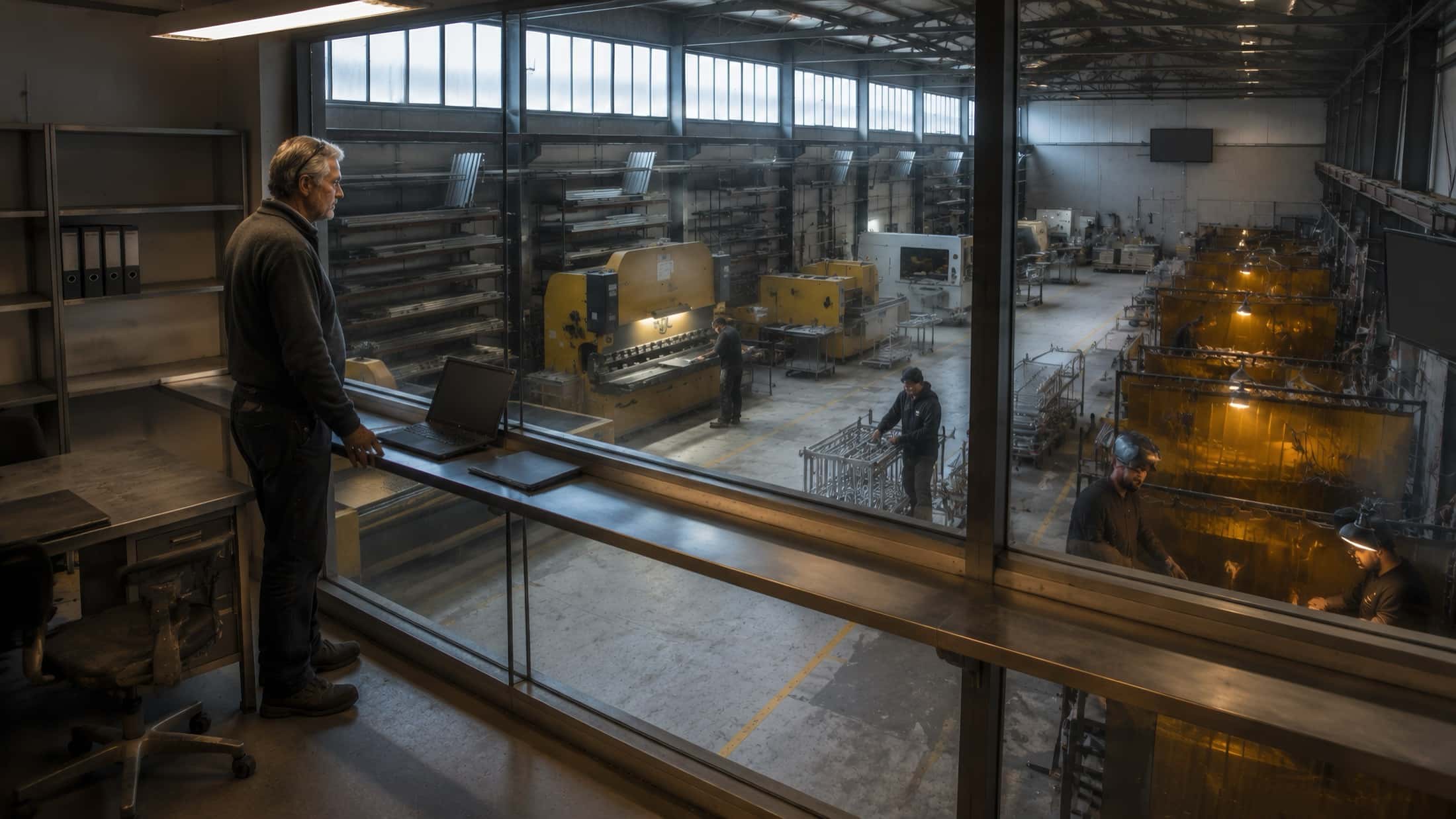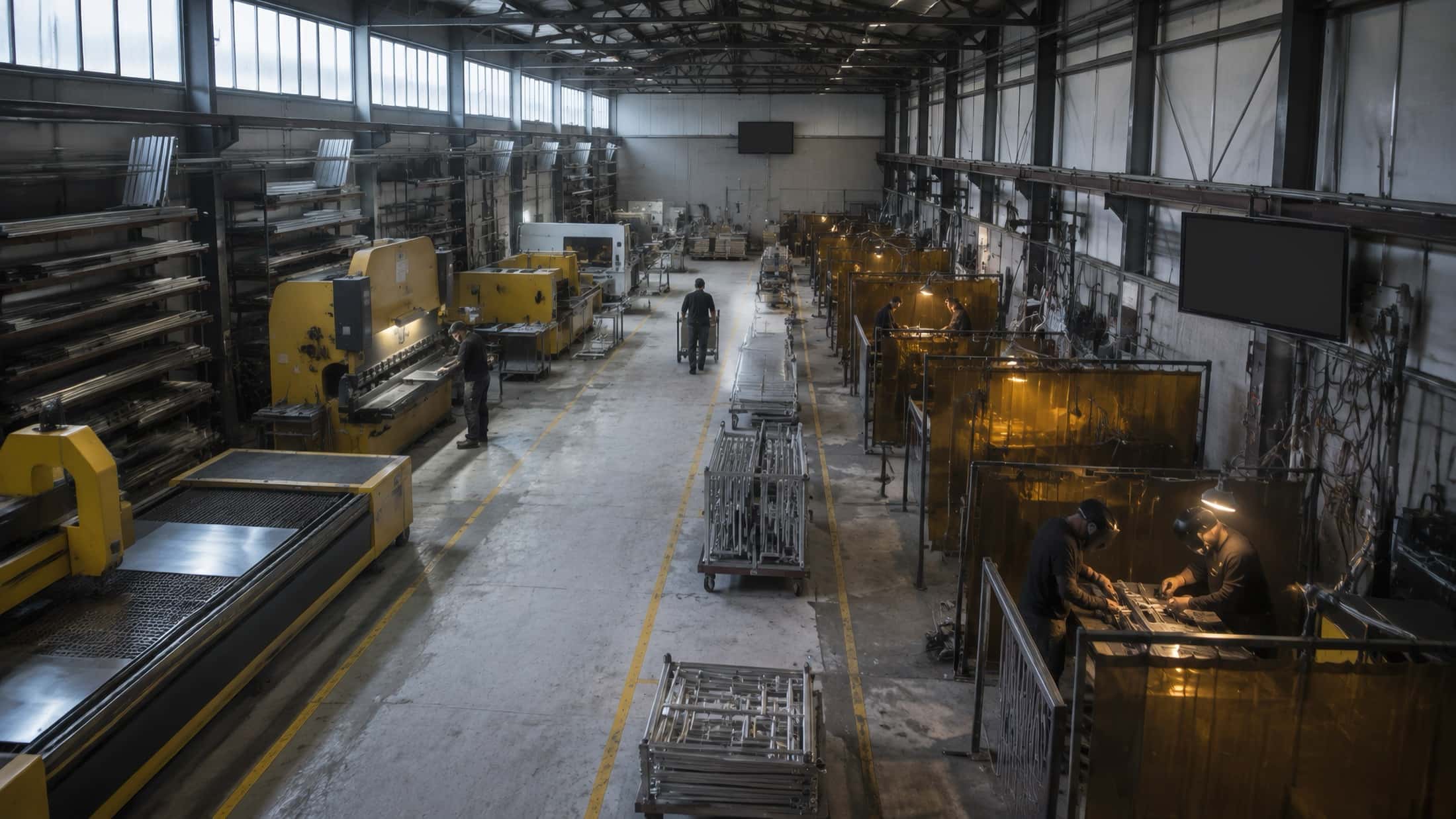
The main aisle of a metal fabrication shop, daylight from the clerestory windows and warm task lamps over each bench.

Management Systems

Your company.In real time.

Production, inventory and sales systems built to measure — so you can see what is happening, decide quickly, and shift into second gear.

A company that can see itself moves faster. 

What you measure in the morning gets fixed before noon. 

We build custom management systems — production, inventory, quoting, traceability — shaped around the way you already work, not the other way around. Not software to adopt: a tool that looks like you.

Before

Three versions of the same number, and nobody is wrong.

This is not an organisation problem. It is a visibility problem: the information exists, it is just spread across six heads, four spreadsheets and a whiteboard.

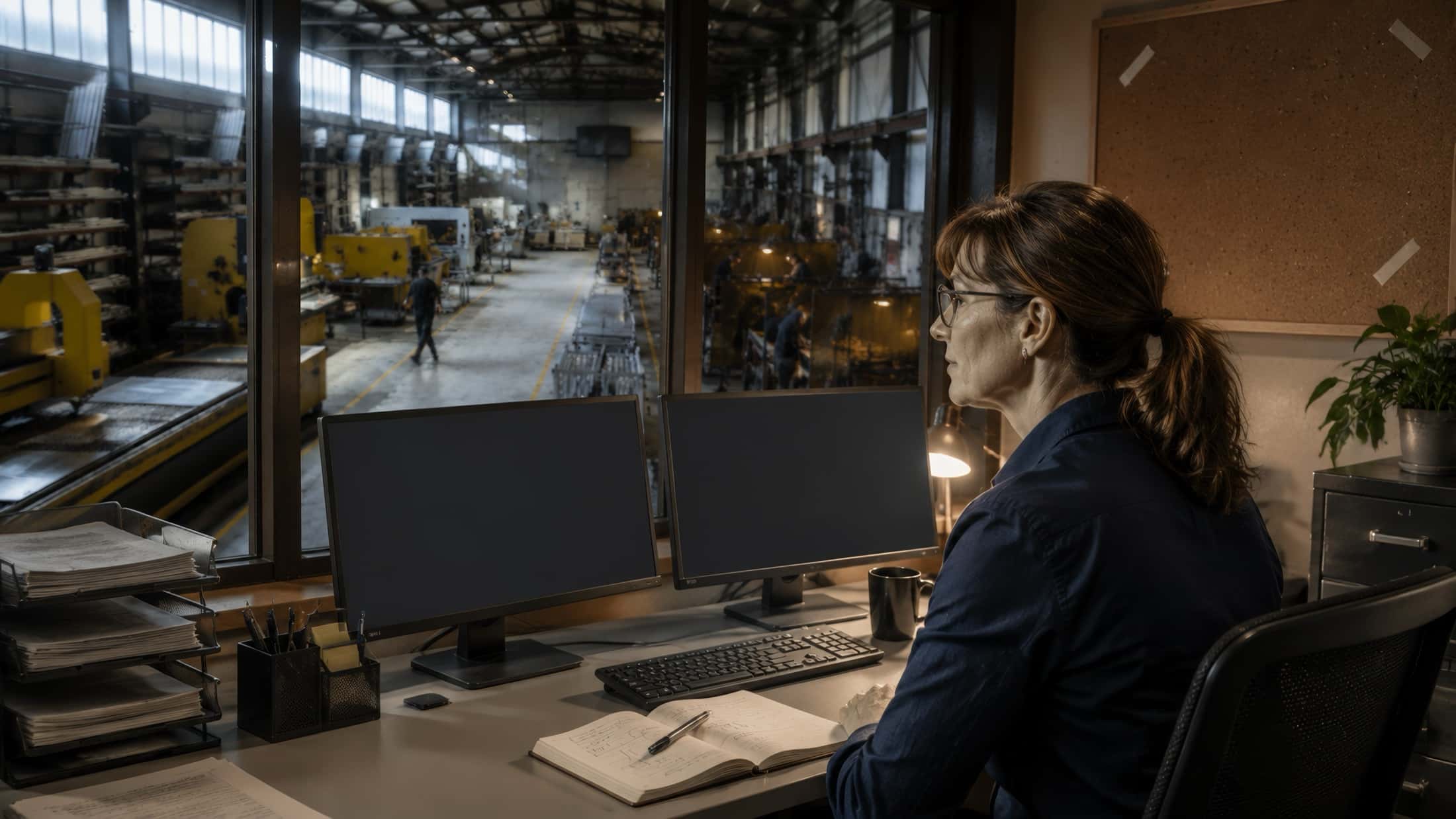
A glassed-in planning office above the shop floor; on the wall, an empty cork board with nothing left but the pinholes.
  1. 01

    Progress lives in someone's head

    "Where is the Delarosbil order at?" The answer exists. It is at the back of the shop, on two legs, and it is busy.

  2. 02

    Inventory is accurate until someone checks

    The system says 142. The aisle says something else. So you buy twice, or you stop production on a Tuesday morning.

  3. 03

    A quote takes two days

    Long enough to call three people back, dig up what you charged last time, and hope aluminium hasn't moved since.

  4. 04

    You find the problem at invoicing

    The job went sideways at the brake three weeks ago. You learn about it while calculating the margin, when there is nothing left to fix.

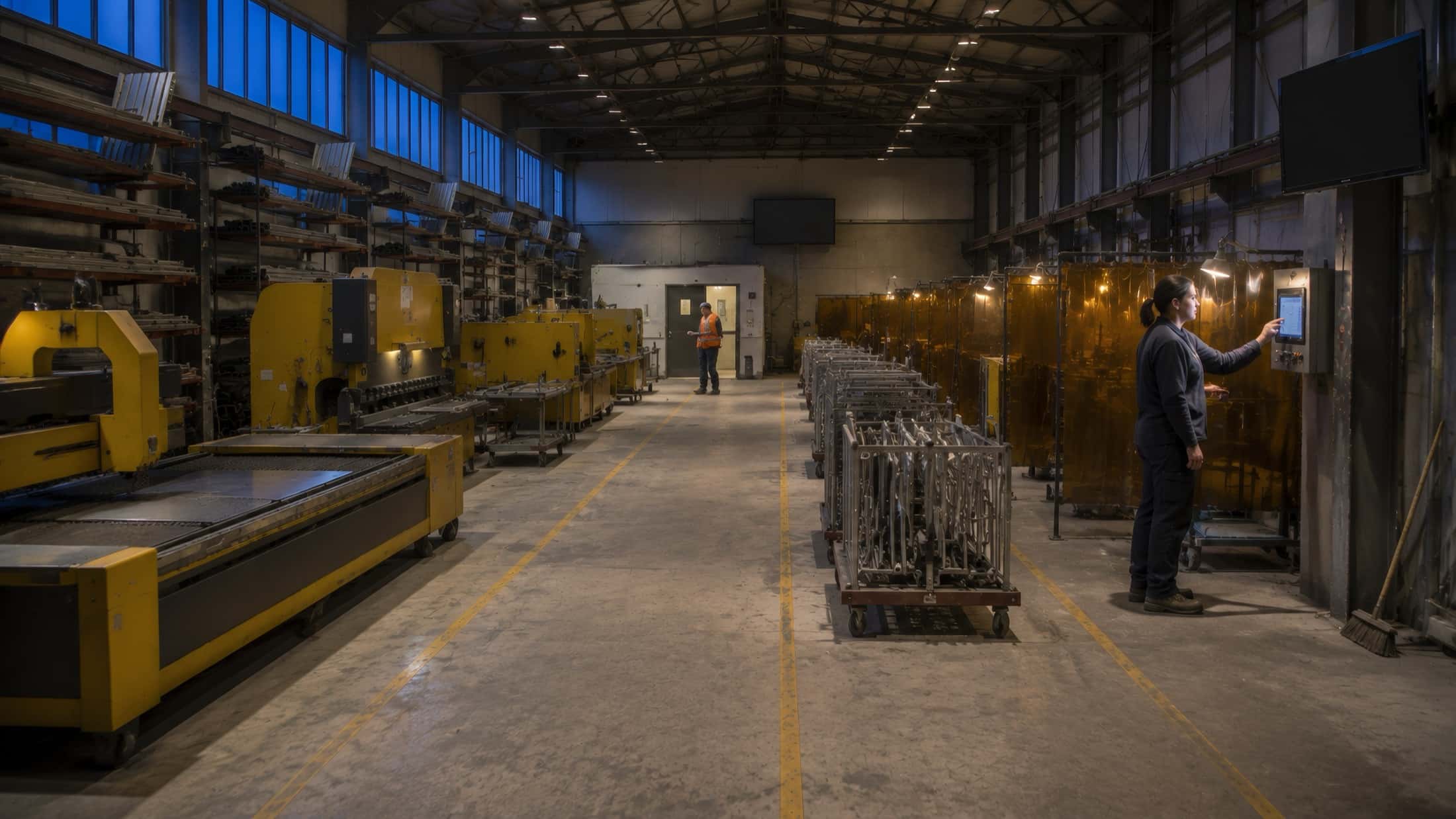
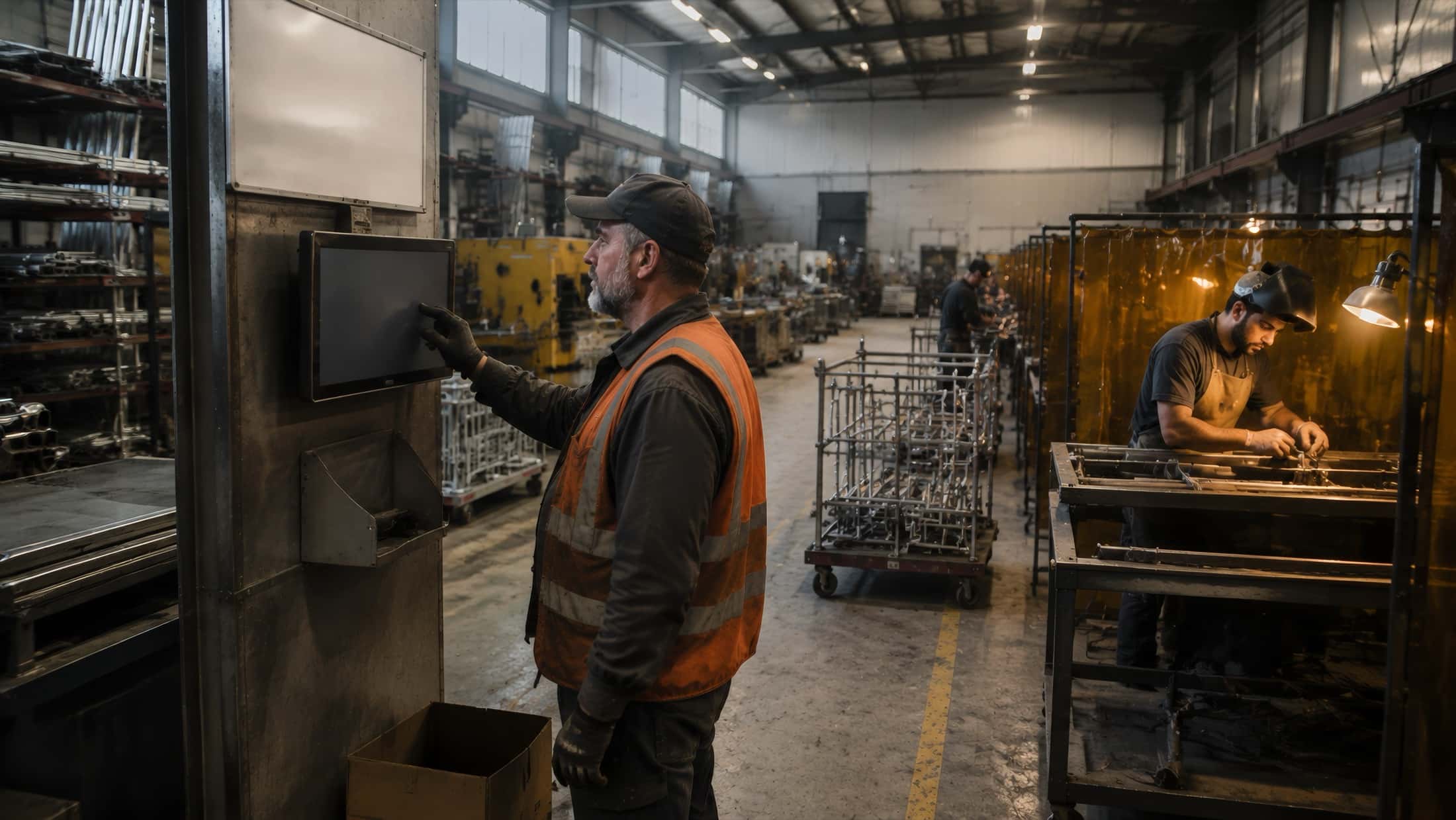
A shop foreman reads a wall terminal; beside it the whiteboard is wiped clean and the document holder is empty.

What changes

The whiteboard hasnothing left to say.

The modules

Seven screens. One single truth.

Every module reads and writes to the same database. What a welder logs at 10:42 AM shows up in the job margin, in the machine load and in the month-end report — without anyone retyping a thing.

Métalec Fabrication inc. does not exist. It is a fictional 84-employee manufacturer — aluminium and steel structures, Saint-Hyacinthe, Quebec — that we built from scratch to show a complete system. The seven screens below all come from one data set frozen at Wednesday, March 4, 2026, 10:42 AM: the figures reconcile from one screen to the next because that is exactly what a real system does. Yours would show yours.

01

The production dashboard

42 open orders, 5 late, and which ones.

The state of the shop on one page: open orders with their current station and real progress, each machine's load against target, and the four things worth your attention today. The laser is at 94 %, powder coating at 62 % — the bottleneck is not where you thought.
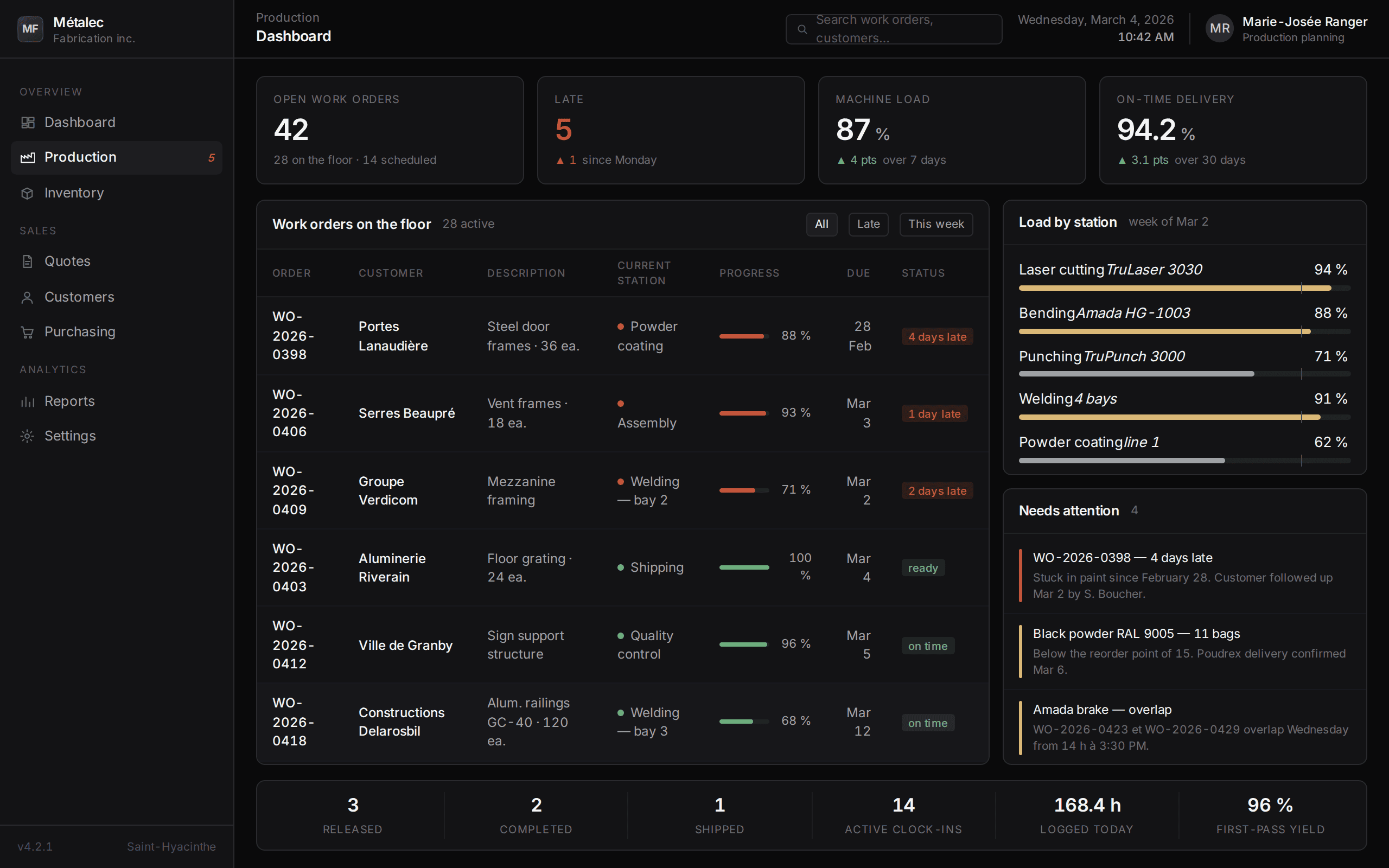
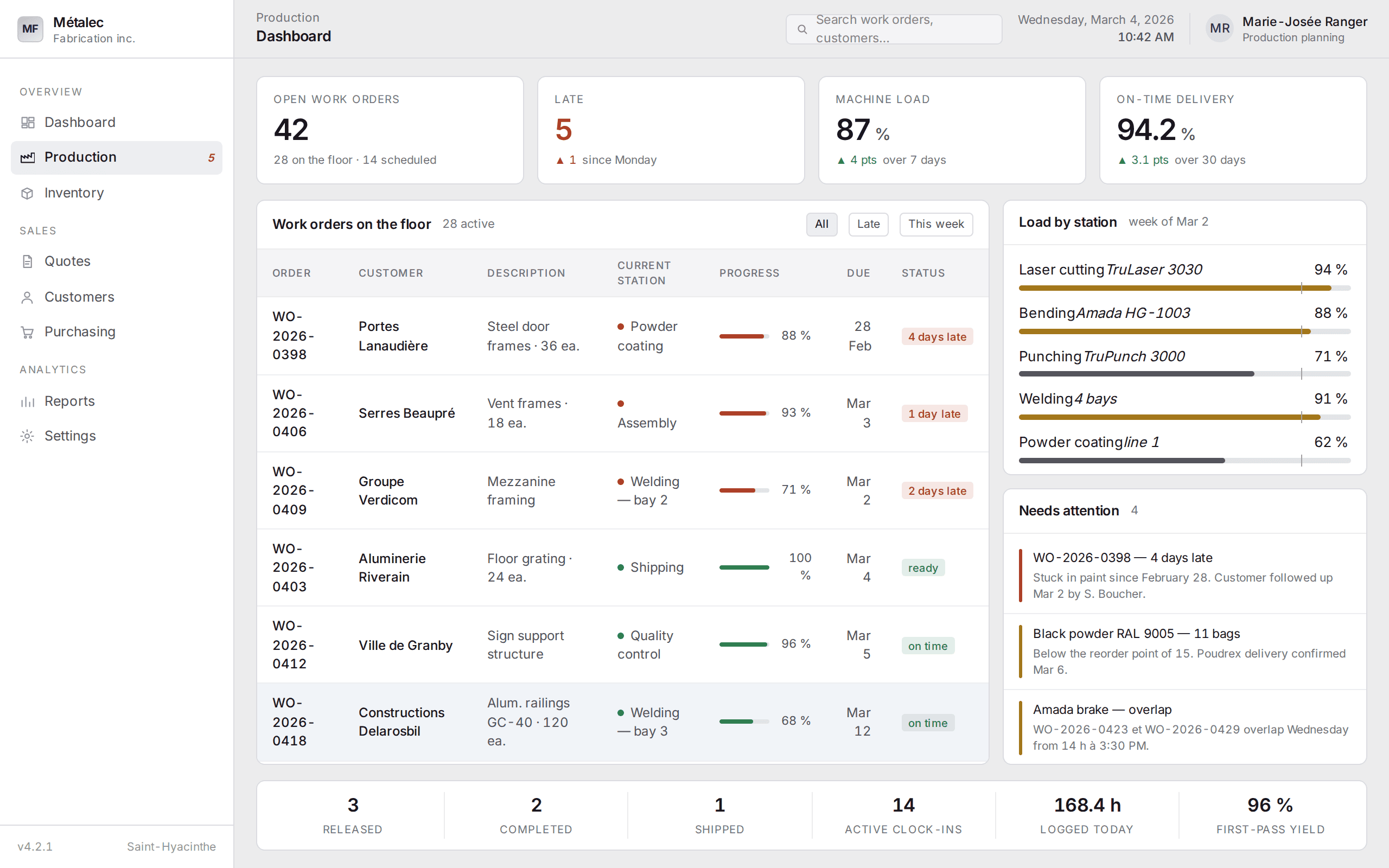
Production dashboard: 42 open work orders, 5 late, load by station and today's alerts.
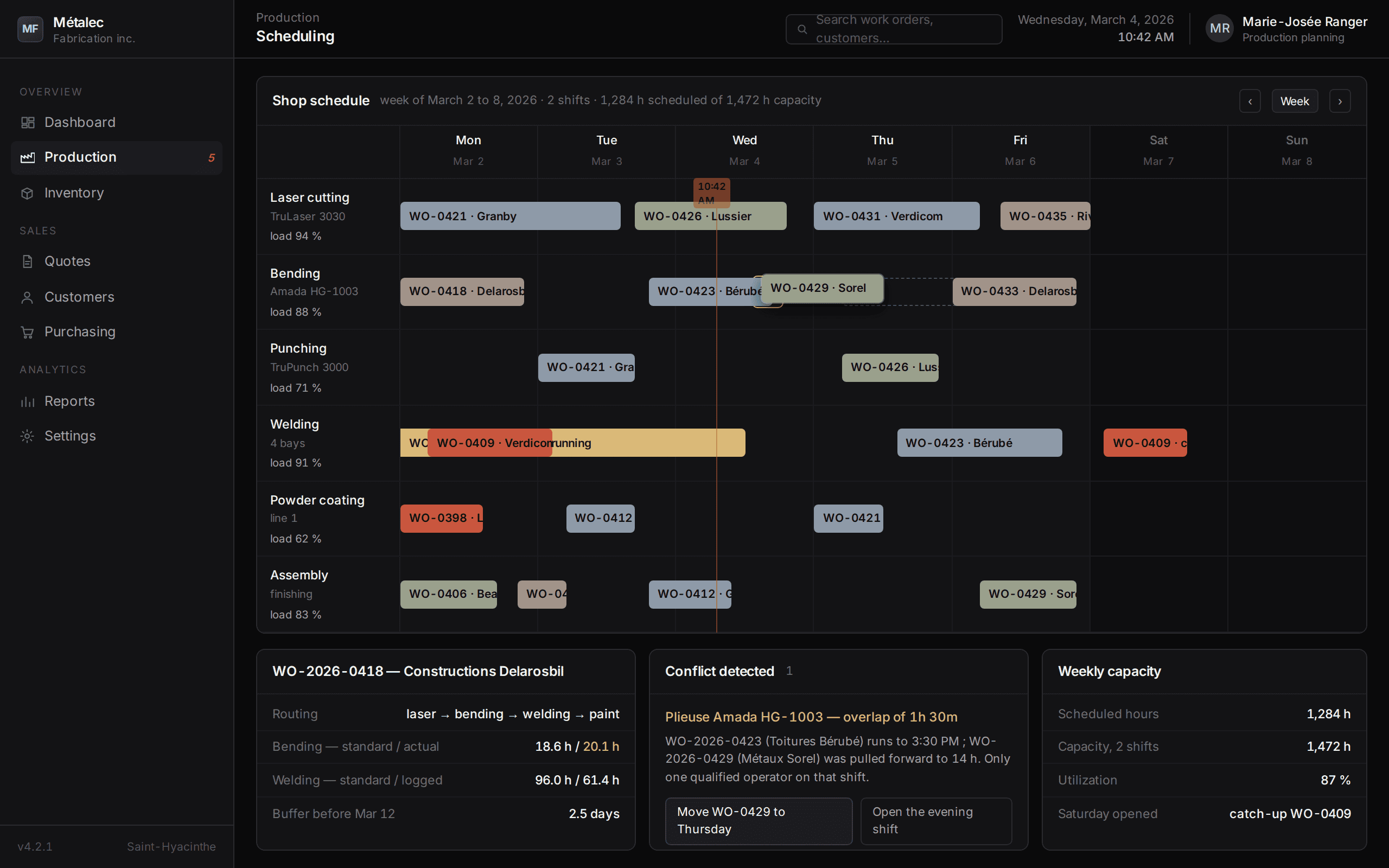
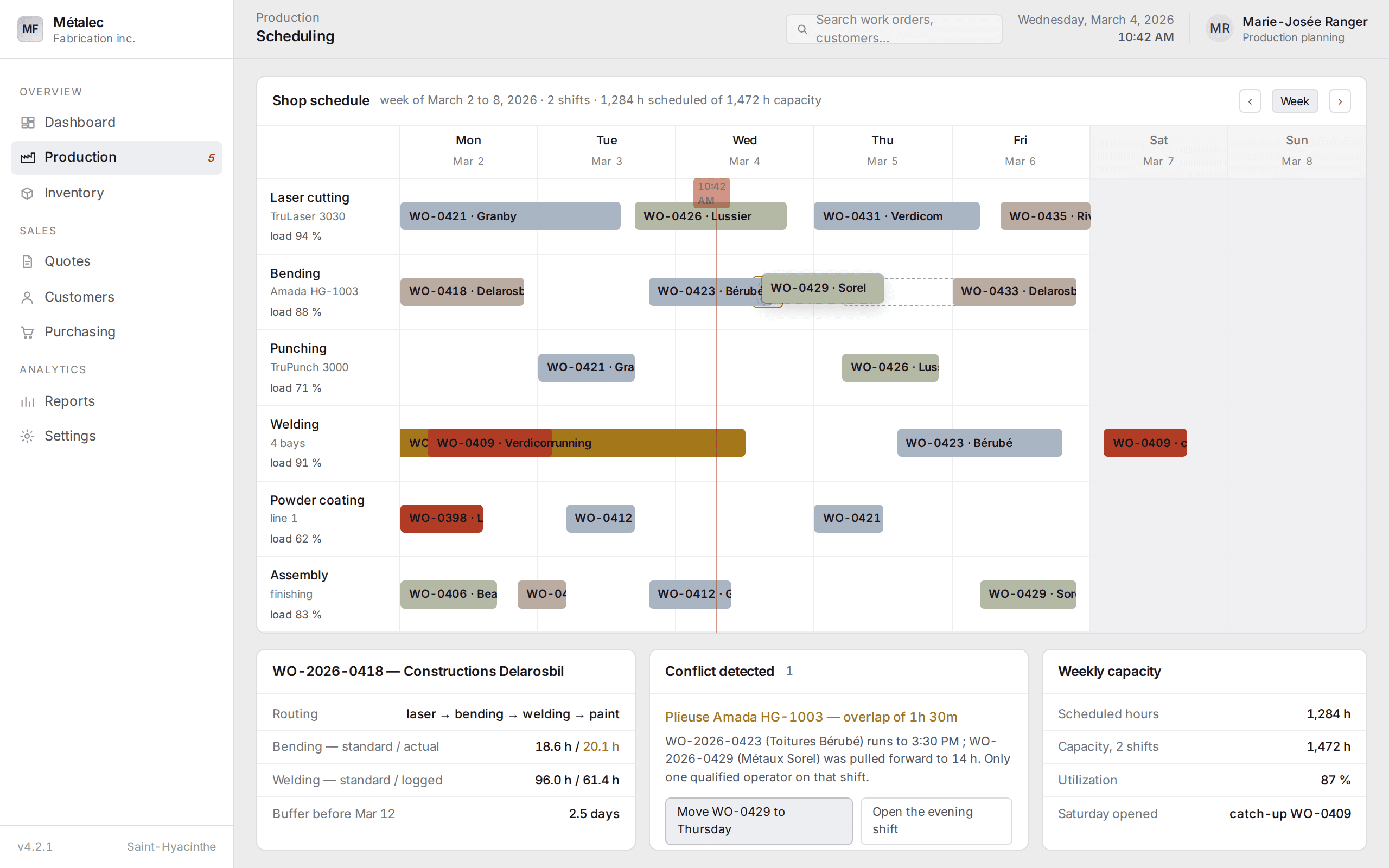
Weekly shop schedule as a Gantt chart, six stations, two shifts, with an overlap flagged on the press brake.

And when you move an order, the system flags the conflict before the operator discovers it.
02

Inventory, to the minute

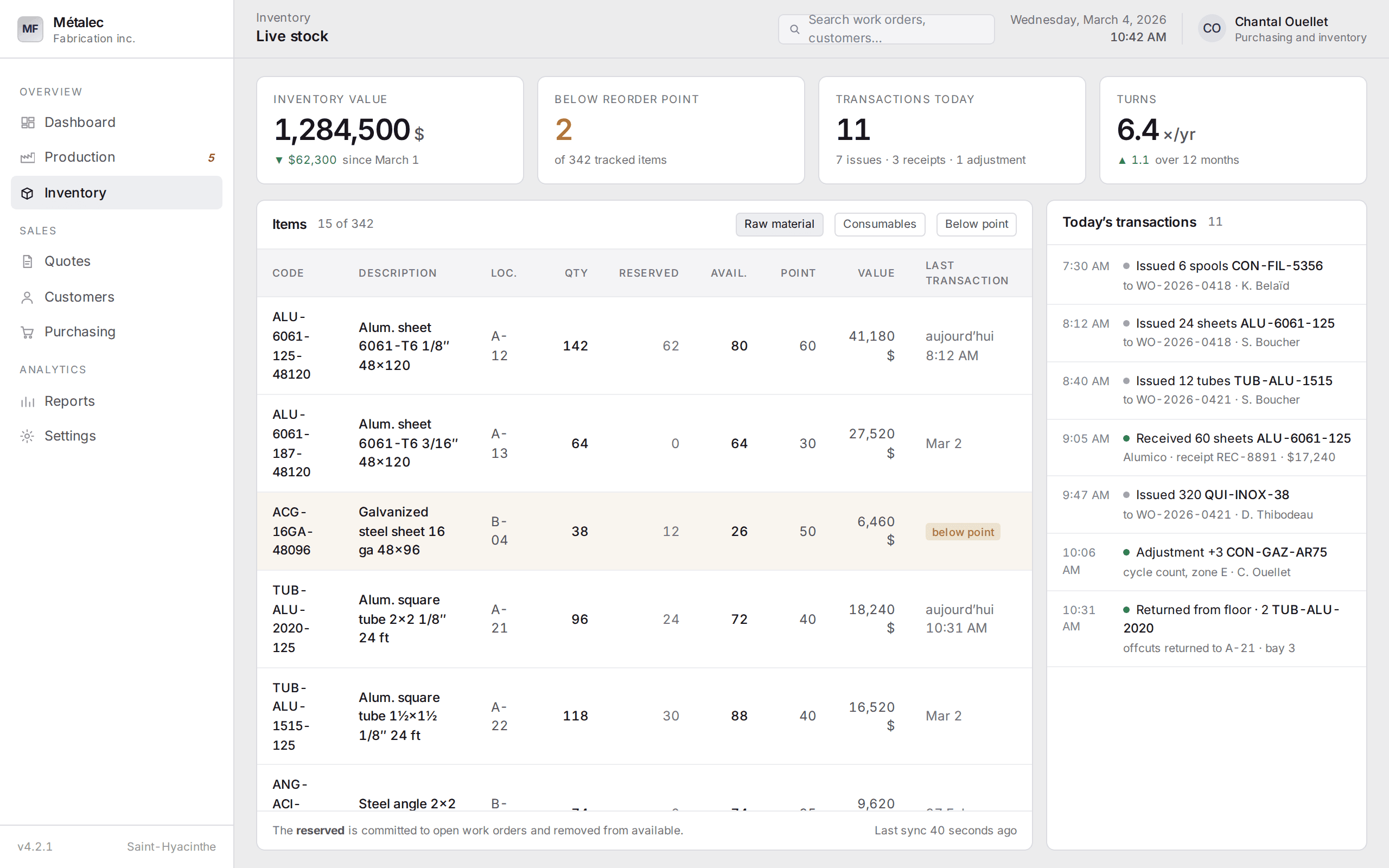
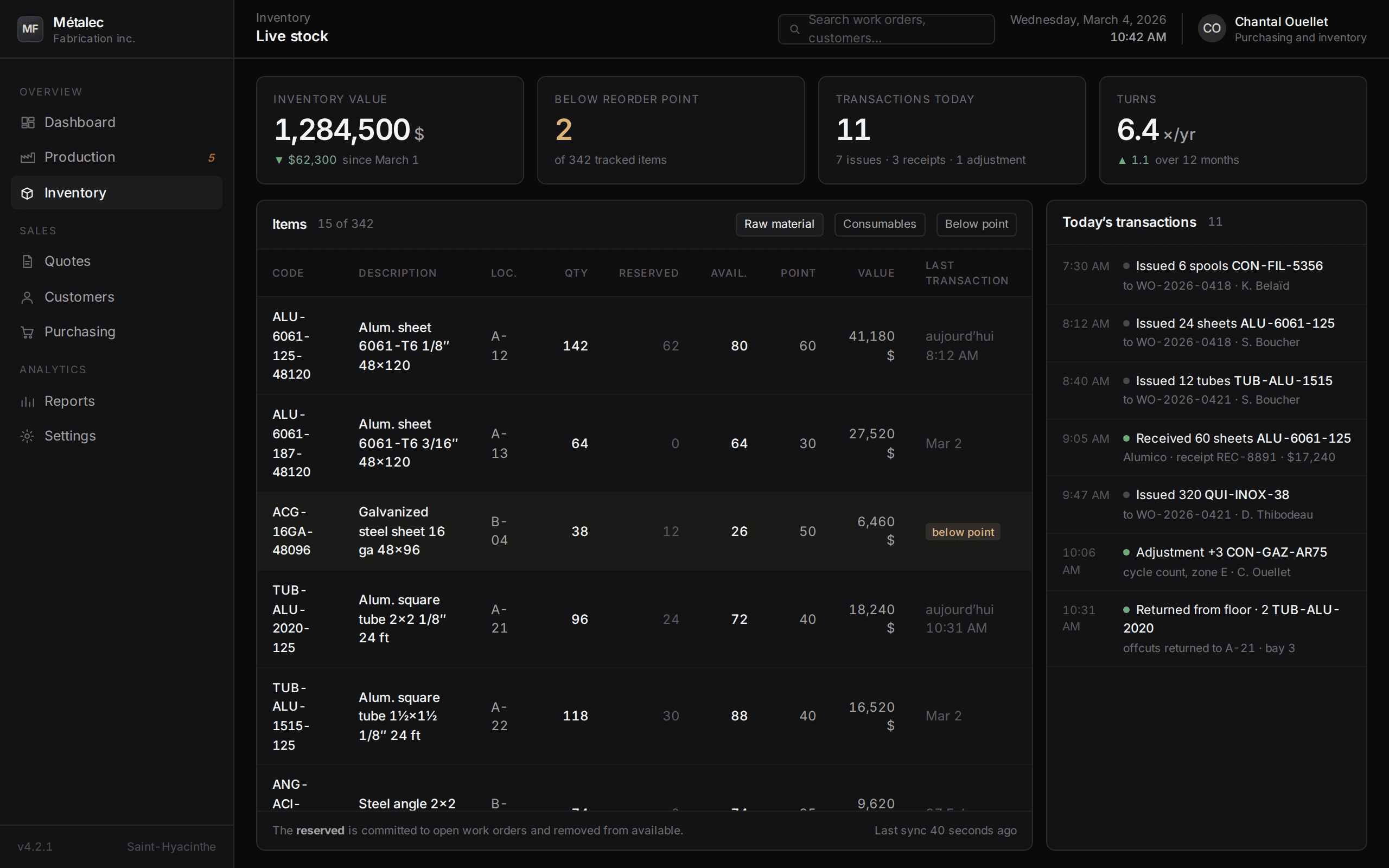
142 sheets. 62 reserved. 80 actually available.

The column that changes everything is not the quantity, it is the reserved: what is already committed to an open order and must not be counted twice. Reorder points warn you before the stockout, not after, and every transaction is timestamped with its order and its owner.

Live inventory: codes, locations, quantity, reserved, available, reorder points, and today's transaction feed.

03

A quote in twenty minutes

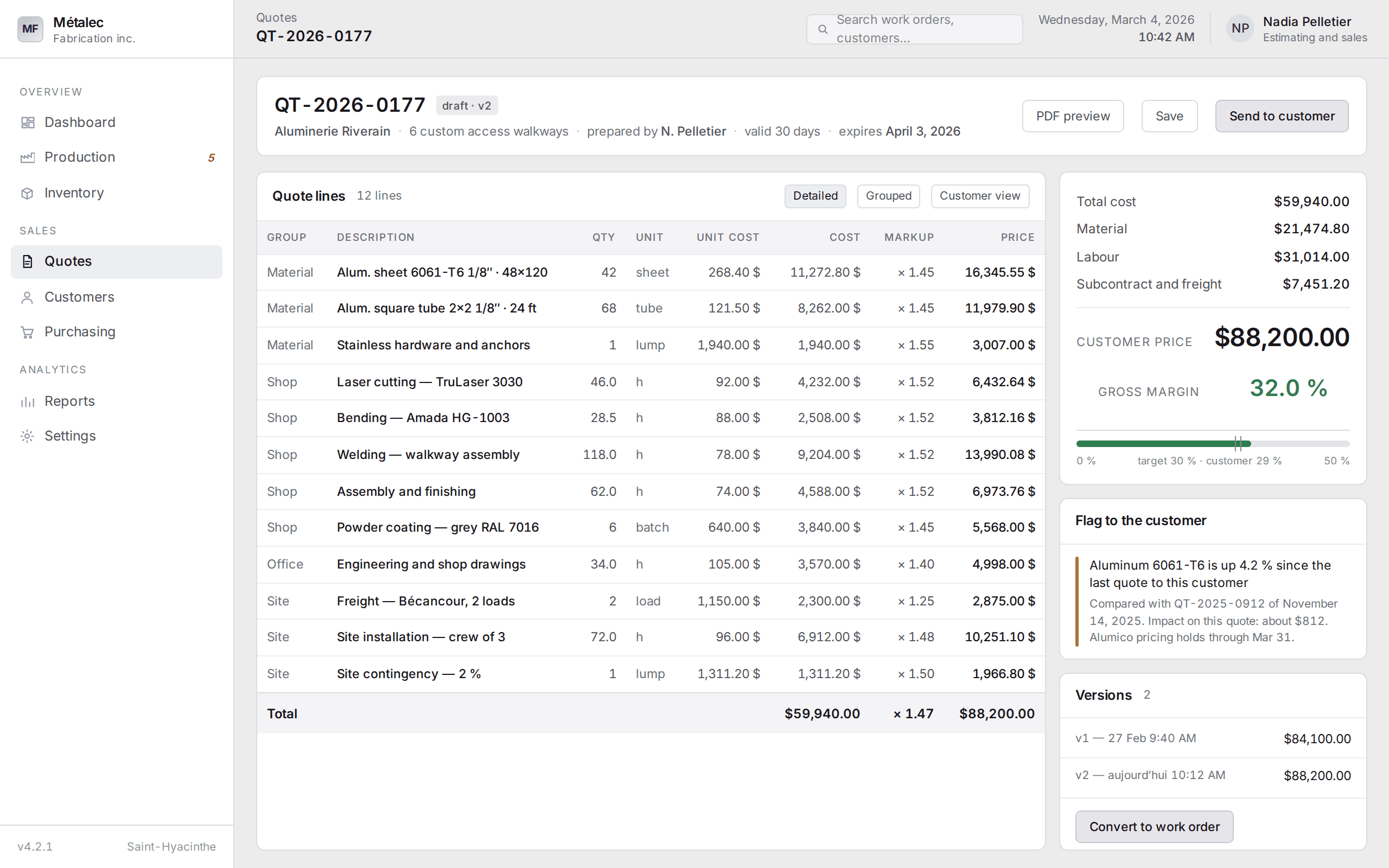
The margin calculates itself while you type.

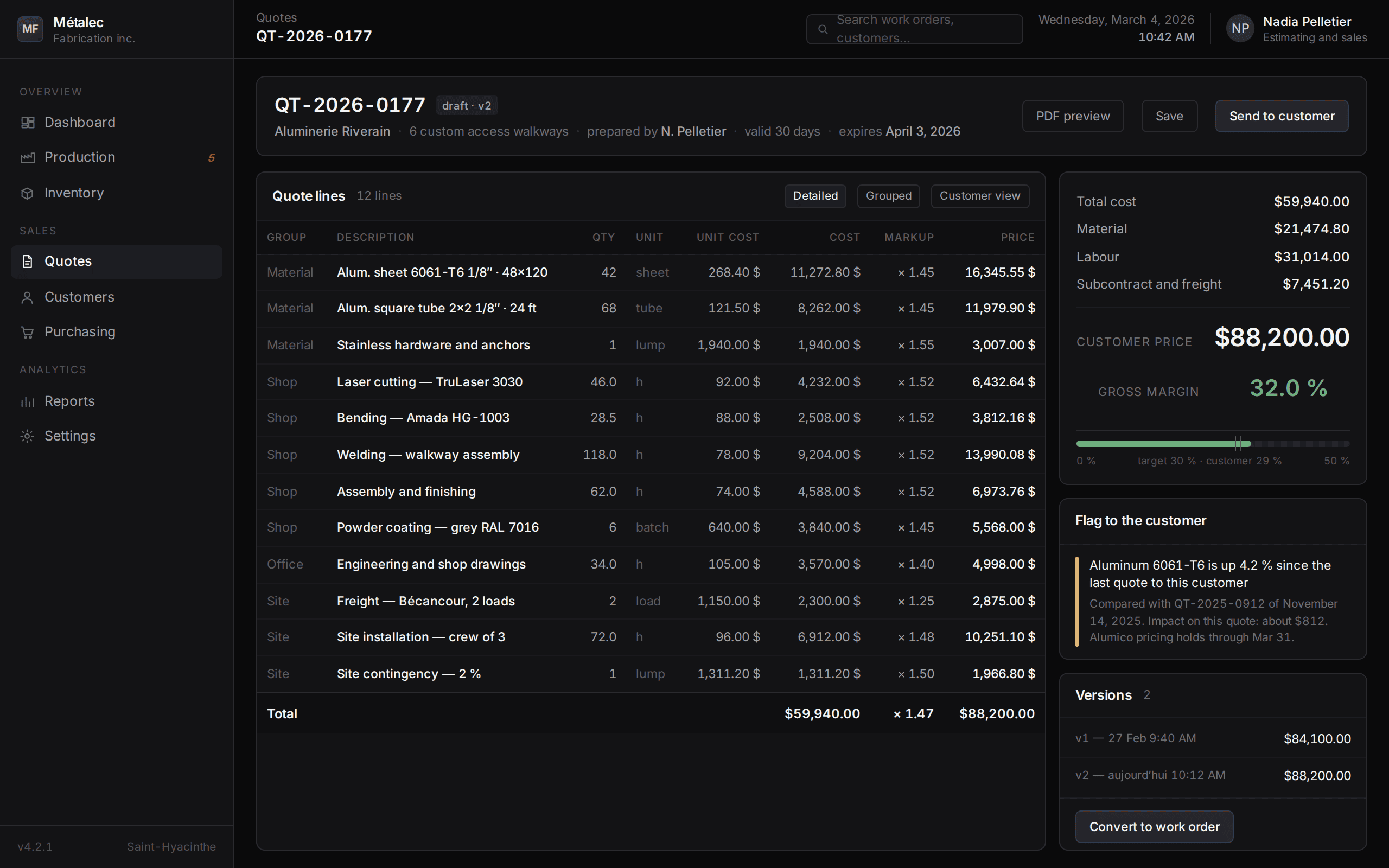
Materials come from inventory, labour rates from your own stations, and the margin displays live against your target and against this customer's average. The system flags that aluminium is up 4.2 % since the last quote to this customer — $812 nobody would have caught. One button turns it into a work order.

Quote editor: twelve cost lines, markups, and a 32.0 % margin calculated live against target.

04

The order book, in plain sight

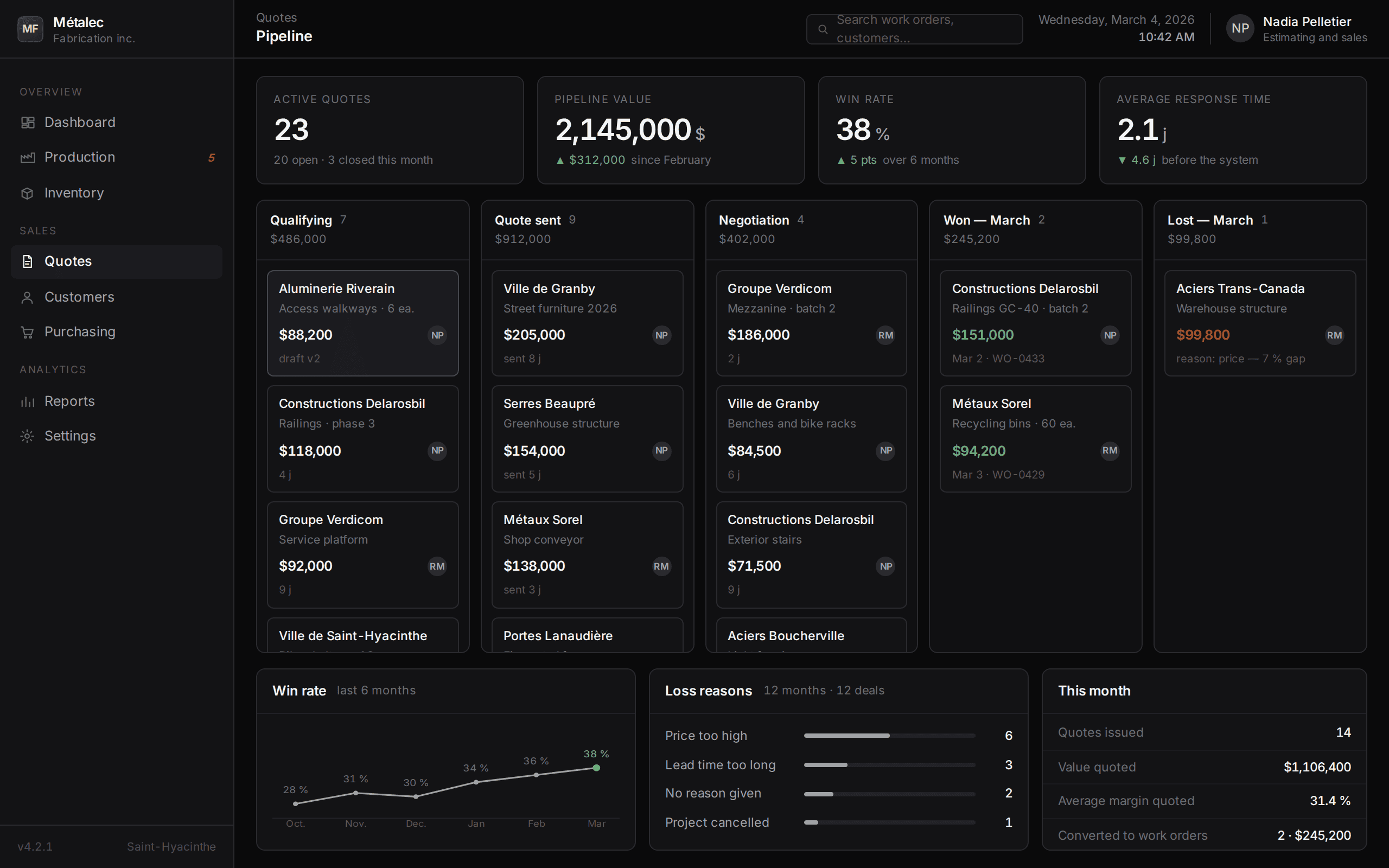
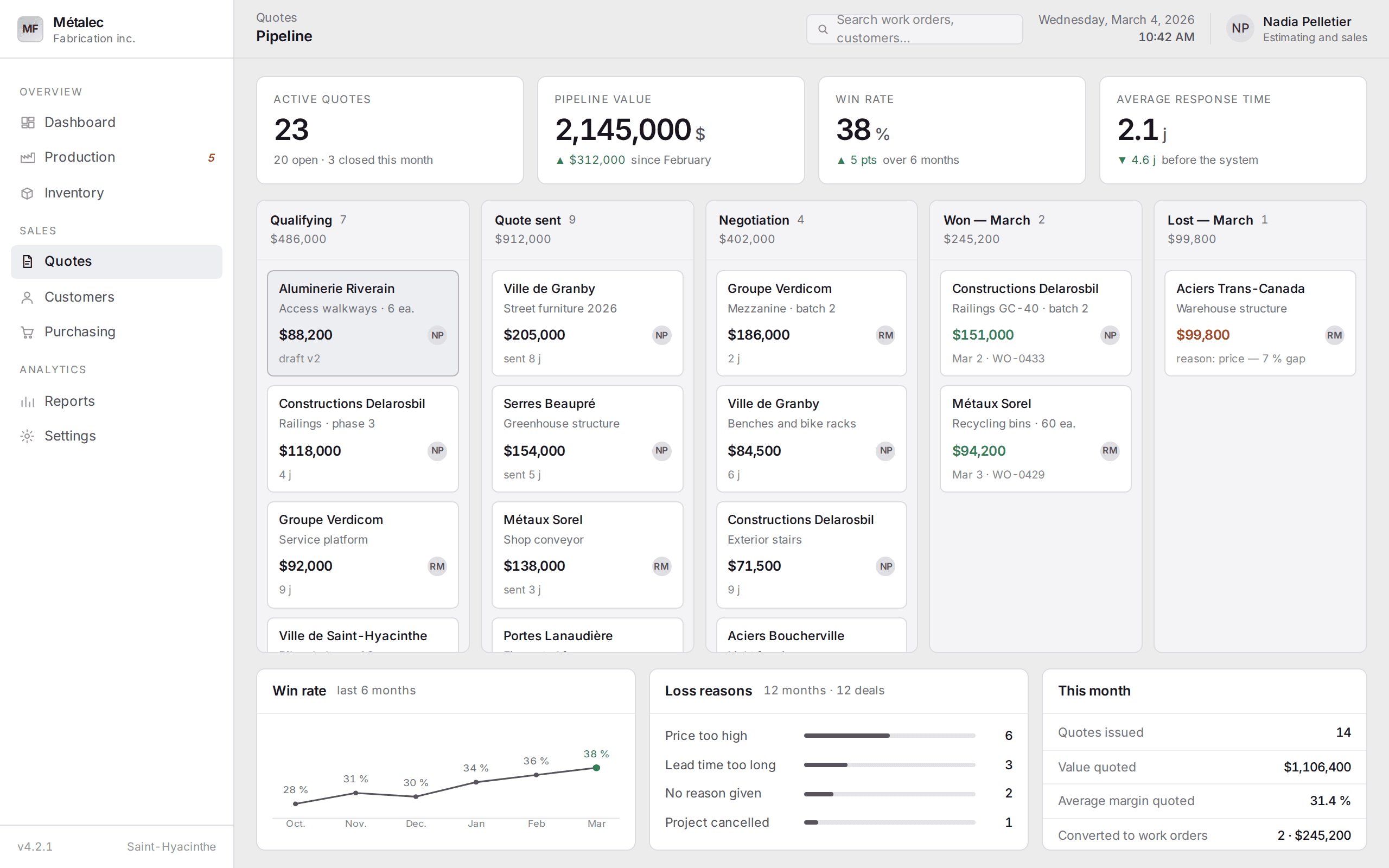
$2,145,000 in play, and where every deal stands.

Twenty-three active quotes, sorted by stage, with their age and their owner. Deals with no follow-up in twelve days flag themselves. And loss reasons are counted — six times price, three times lead time: that is a business decision, not a hunch.

Sales pipeline in columns: qualifying, sent, negotiation, won, lost, with values and win rate.

05

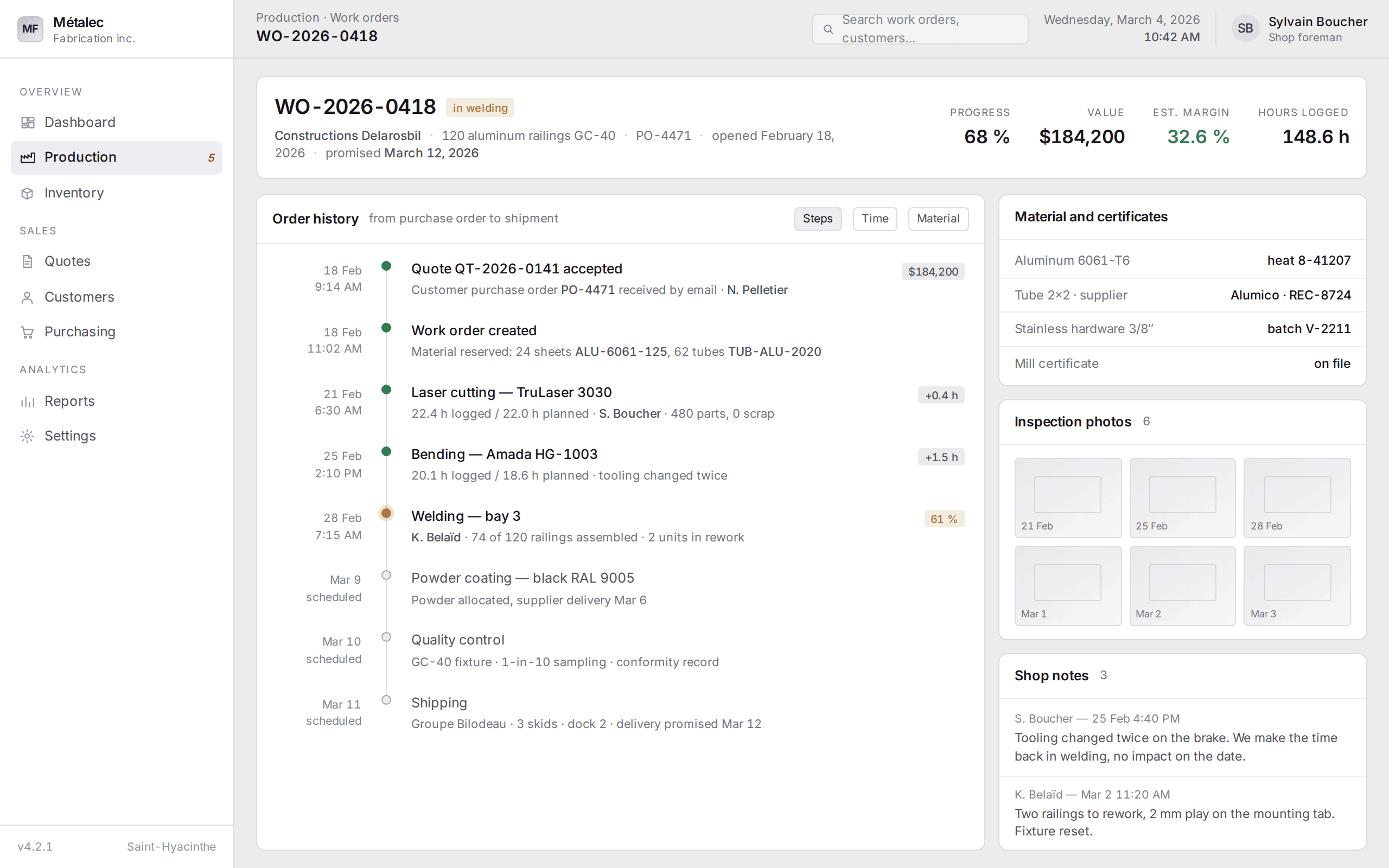
The history of a work order

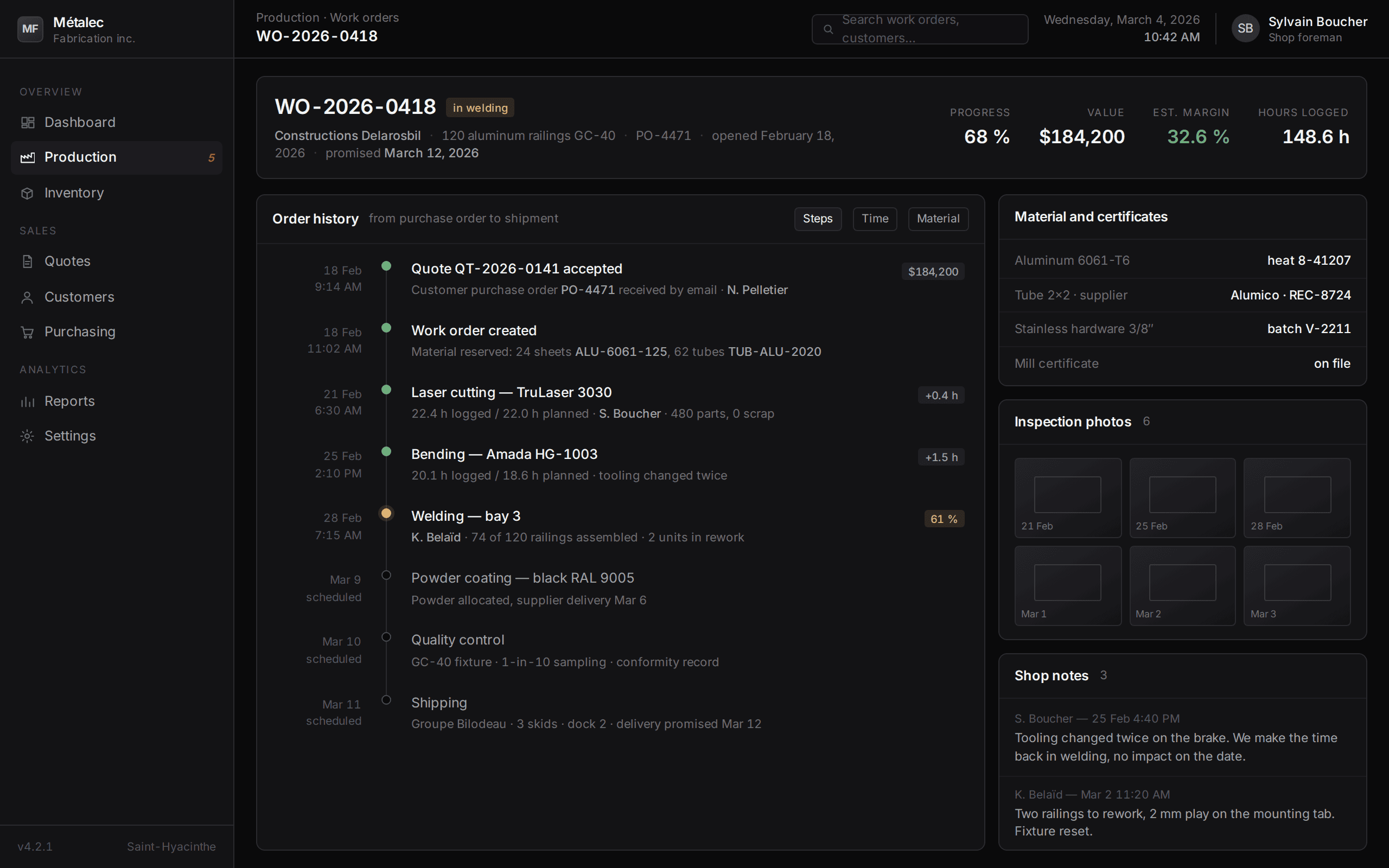
From purchase order to shipment, timestamped.

One order, its whole story: who did what, when, in how long, with which material heat and which certificate. Bending took 20.1 hours instead of 18.6 — the variance is there, dated, explained by the foreman that same evening. This is the screen you open when a customer calls, and the one you open in an audit.

Full history of a work order: eight timestamped steps, material heats, inspection photos and shop notes.

06

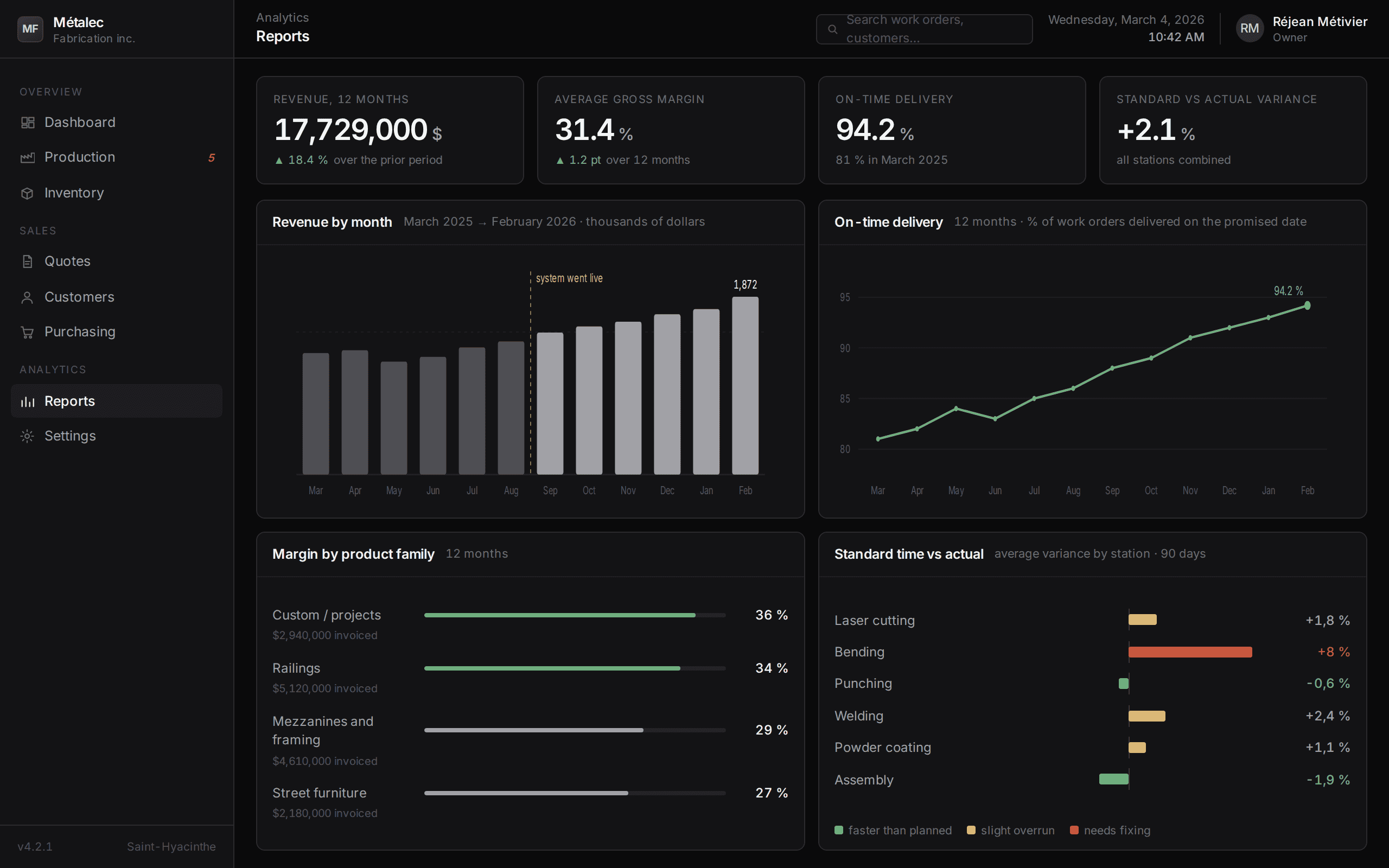
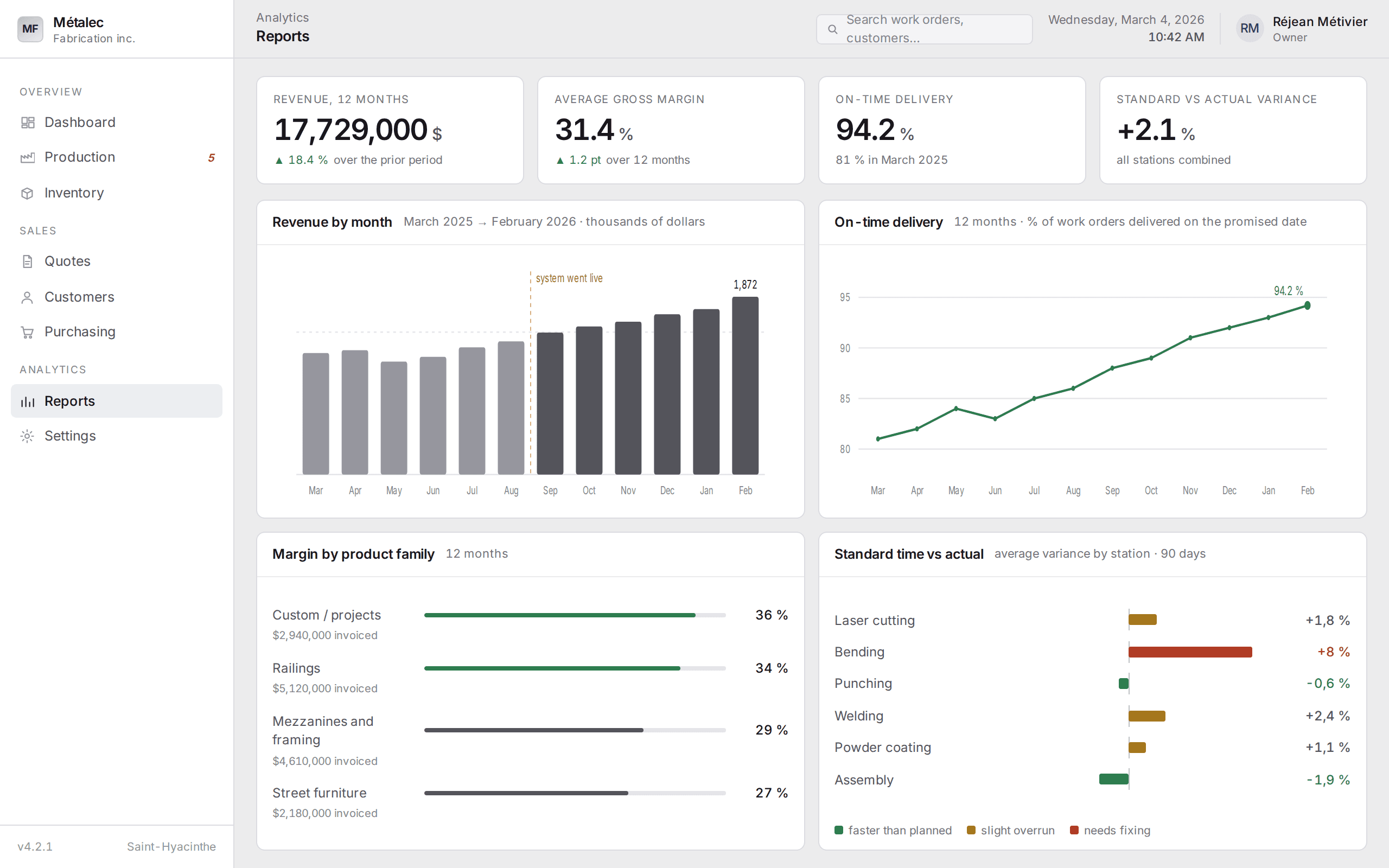
Reports that tell you something

Twelve months, and the moment the curve changes.

Revenue by month, on-time delivery, margin by product family, and the gap between standard time and actual time at every station. On this screen exactly one number is red. It is the one that pays the most.

Twelve-month reports: revenue by month, on-time delivery, margin by family and standard versus actual variance.

07

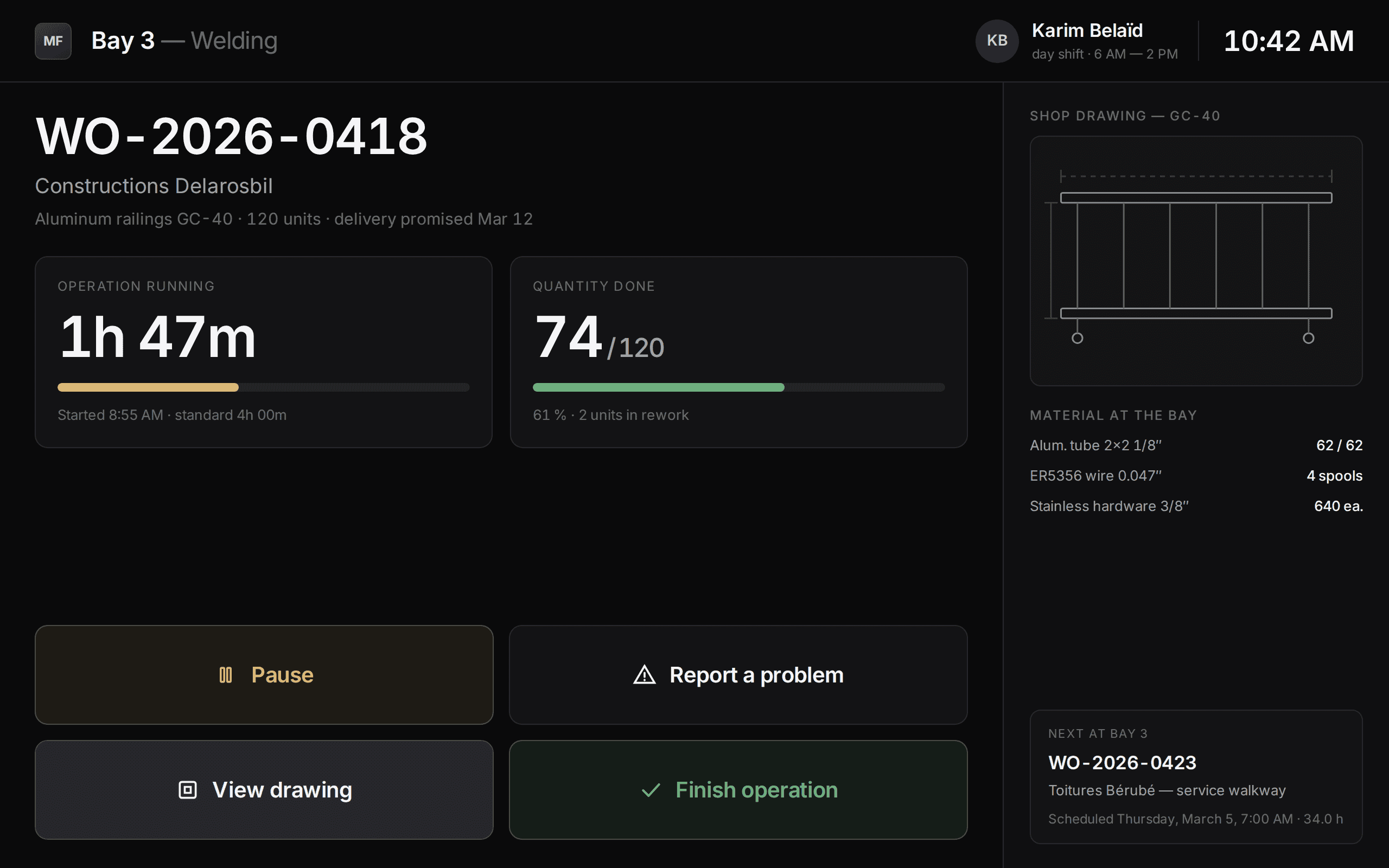
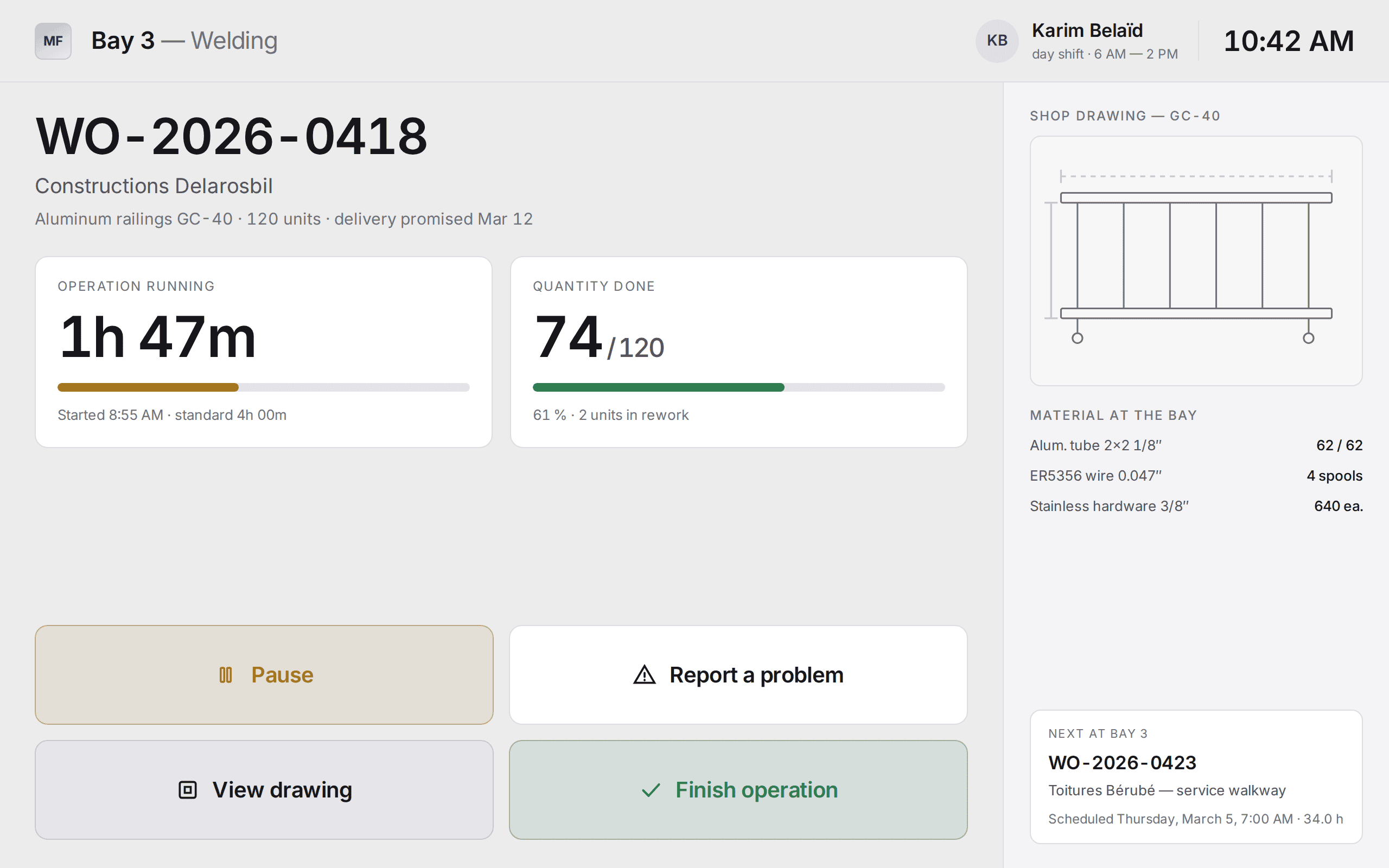
The shop floor terminal

Four buttons the size of a work glove.

The system does not live in the office alone. At the bay, the screen shows the running order, elapsed time, quantity done, and four actions: start, pause, report a problem, finish. The drawing is right there. Nothing to write down, nothing to report at the end of the day.

Full-screen shop floor touch terminal: running order, elapsed time, quantity done and four large buttons.
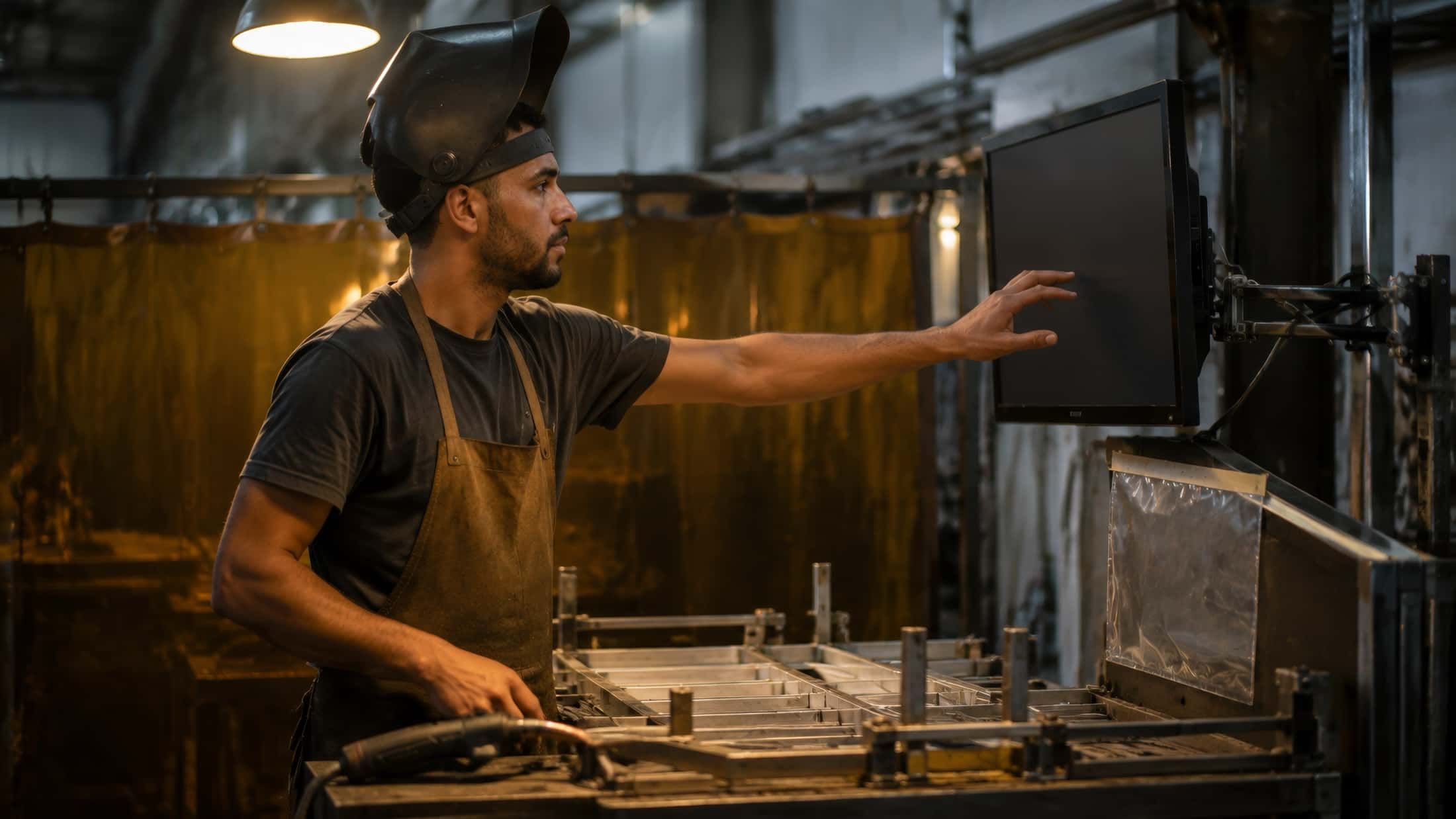
A welder, helmet flipped up, closes out an operation on the industrial screen at the corner of his bench.

On the floor

The shop isn't filling outpaper. It's working.

The results

What Métalec sees now, and could not see before.

The figures below belong to the demonstration scenario, not to a client. What is real is what the system makes visible — and the fact that you can act on it the same day.

94.2 %

on-time delivery

81 % twelve months earlier. The curve straightens out from the moment the system went live, in September.

2.1 days

to answer a request for pricing

Six and a half days before. The first to answer is not always right, but he is often the only one still in the running.

87 %

machine load

And powder coating at 62 %. The next investment gets decided on that line, not on a hunch.

+8 %

variance at the press brake

The only red number in the whole system. It is the one that pays the most: three weeks earlier, nobody would have seen it.

None of these gains come from the software. They come from decisions somebody was able to make because he could see the problem while it was still repairable.

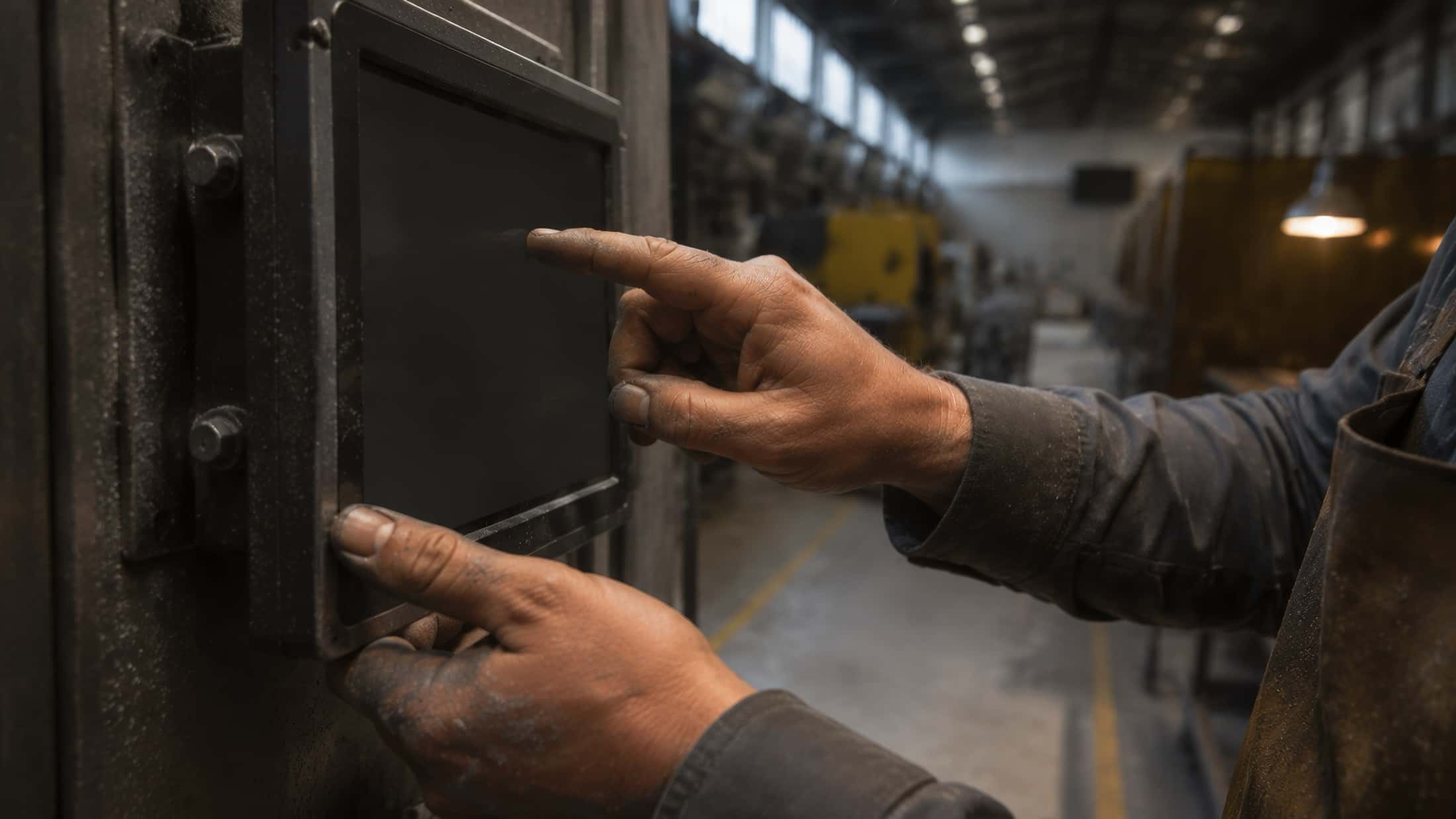
Two working hands, aluminium dust in the creases, on the glass of an industrial terminal.

In use

A system you touchten thousand times.

The method

We watch, we build, we stay.

A custom system is not sold off a demo. It is built with the people who will use it every day.

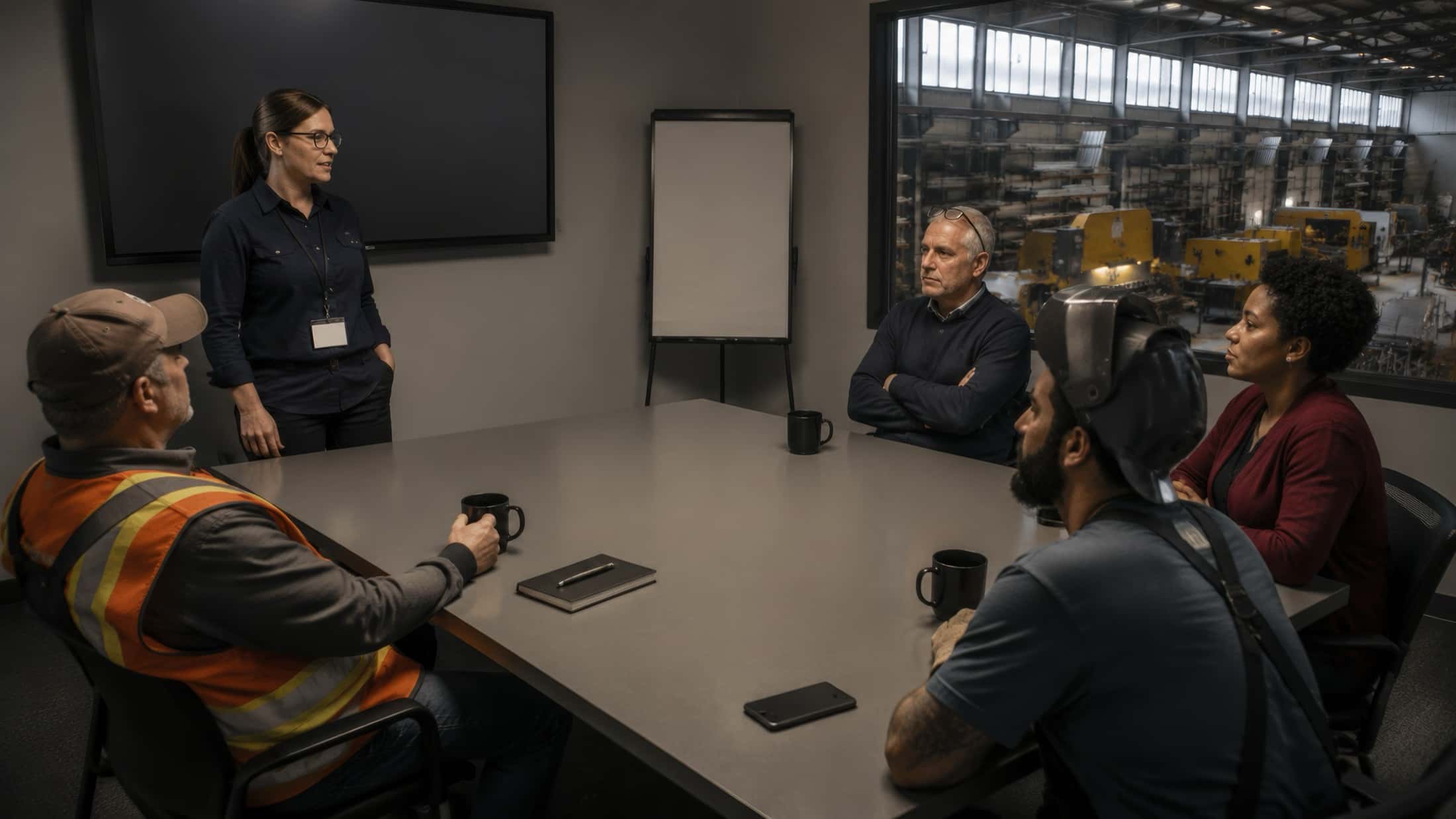
Morning production meeting: four people around a bare table, a large wall screen, no paper anywhere.
  1. 01

    We come and watch you work

    Two or three days on site, following one order end to end and noting every place where information stops, gets retyped or goes missing. We leave with a map of your company as it actually runs — not as it is supposed to run.

  2. 02

    We build around you

    Nothing imposed, nothing generic: your routings, your vocabulary, your pricing rules, your exceptions. Under the hood, Laravel applications and databases designed to carry millions of rows and twenty years of service — but that is our problem, not yours.

  3. 03

    We deliver in pieces

    The first module goes live in weeks, not at the end of a year. Every delivery is usable on its own, and every piece of feedback from the shop corrects the next one. Nobody signs a cheque with their fingers crossed.

  4. 04

    We stay afterwards

    A management system lives as long as the company does. Ours grows with it: new stations, new products, new rules. Our oldest systems are still running, and that is the only measure of quality that counts.

Who it is for

Companies that outgrew their spreadsheets.

The signal is always the same: it works, but it rests on the memory of three people — and one of them is about to retire.

Manufacturers and custom fabrication shops
Metal, wood and plastics fabrication
Distribution and warehousing
Service companies running projects
Construction and installation
Food processing
Companies of 20 to 300 employees
Fast growth, or a family handover
An owner at the glass of a mezzanine office, looking down at his shop, a laptop open beside him.

It is not for everyone

If an off-the-shelf product does 90 % of what you need, take it: it will cost less and it will be ready Monday. Custom earns its keep when the way you work is precisely what sets you apart — and a generic tool would force you to give it up.

End of shift: the shop quiet, machines stopped, one terminal still lit down the aisle.

Your company

The day closes withoutleaving anything behind.

Your company

Show us how you work.

An hour on the phone is enough to know whether custom makes sense for you. We say so plainly when it does not.

Creative Drops — immersive environments, previsualization and custom management systems. Montreal, Quebec.